Dubai remains one of the most attractive places to build a career, grow a company, and hire international talent. As hiring activity increases, employment visas become an essential step for both employers and employees who want to work legally in Dubai.
For many people, one question appears early in the process. How much does it actually cost to obtain a work visa in the UAE? The 2-year employment visa in Dubai often varies depending on several factors, which is why the real cost can feel unclear at first.
That’s why in this guide, we’ll explain how this visa works, what influences the total cost, and what steps employers and employees should expect when applying in Dubai.
What Is a 2-Year Employment Visa in Dubai?
A 2-year employment visa grants a foreign employee legal residence in the UAE under the sponsorship of a company. It allows a foreign employee to legally reside in the UAE and work for the company that has sponsored the application.
For employees, it transforms a job offer into lawful residency, ensuring all legal requirements are met. For employers, it’s a core compliance requirement that supports onboarding, payroll, labour approval, and long-term workforce planning. It’s also part of the broader legal framework for hiring in Dubai.
What this Visa Allows
Once the visa and residence process is completed, the employee is legally entitled to live in Dubai and work under the sponsoring company. Specifically, this legal status allows you to:
Legally Work and Reside: Secure the right to live in the UAE and work for your sponsoring employer for a 24-month period (renewable).
Sponsor Dependents: Bring eligible family members (spouse, children, and in some cases, parents) to live with you in Dubai, provided salary requirements are met.
Access Financial Services: Open a local bank account, apply for personal loans or credit cards, and sign a residential lease in your own name.
Obtain a UAE Driving License: Apply for a local license or convert an existing eligible foreign license to drive within the Emirates.
Utilise Essential Services: Register for government and private health insurance, enrol children in schools, and set up utility accounts (DEWA, internet).
Travel Mobility: Exit and re-enter the UAE freely for the duration of the visa (provided you do not remain outside the country for more than six consecutive months).
Path to Long-Term Status: Establish the residency history required to eventually apply for 5-year Green Visas or 10-year Golden Visas, depending on your professional category.
What Does a 2-Year Employment Visa in Dubai Cost in 2026?
The total cost is not a single fixed government fee. Instead, it is commonly presented as an overall estimate because different steps in the visa process carry their own charges.
A practical figure for 2026 is often shown within a broad range. Some Dubai market sources place the total around:
AED 3,000 to AED 7,500 for standard cases
Up to AED 15,000 for premium cases
To understand why these figures vary, it helps to look at the main components that form the overall visa cost.
Cost Component | Estimated Range (AED) | Key Factors |
Work Permit Fee | 250 to 3,450 | Depends on employer’s MOHRE classification tier |
Status Adjustment | 500 to 1,200 | Applicable if the applicant is already inside the UAE |
Medical Fitness Test | 250 to 750 | Standard (24 to 48h) vs. VIP/Express (30min to 4h) |
Emirates ID (2-Year) | ~370 | Fixed government fee (AED 100/year + service fees) |
Residence Permit | 400 to 800 | Issuance and administrative processing fees |
Health Insurance | 600 to 1,200+ | Annual cost varies by coverage level (mandatory) |
Factors That Influence Your Visa Cost
Company Classification: Highly compliant “Category 1” companies pay significantly lower work permit fees than lower-tier businesses.
In-Country vs. Out-of-Country: If an employee is already in Dubai on a tourist visa, a “Status Change” fee (approx. AED 500) is added to the total.
Processing Speed: Opting for Express medical results or “Amer” priority counters can add AED 500 to 1,500 to the administrative overhead.
Professional Support: Using a PRO or document clearing service typically adds a service fee for handling the logistics across various government portals.
Note: While the employer is legally responsible for the recruitment and visa issuance costs in the UAE, candidates should verify the specific insurance coverage provided, as this is the most variable part of the price.
Requirements for a 2-Year Employment Visa in Dubai
Securing a 2-year employment visa in Dubai starts with preparing the correct paperwork from both the employee and employer. While the process is linked to employer sponsorship, approval depends on documents submitted by both parties, not just the company.
In many cases, the employer handles most of the submission work, but the employee still needs to provide the correct documents on time. For that reason, it helps to look at the requirements as a shared process where both parties need to be aligned from the start.
Documents Needed
For Employees
Employees must provide identification and supporting documents that confirm their eligibility for residence and employment in the UAE. These documents help authorities verify identity, complete medical screening, and process the residence permit.
Typical documents include:
Valid passport with at least six months validity
Recent passport-sized photograph
Medical fitness test results from an authorised centre
Emirates ID application details
Educational certificates or professional credentials, when required
For Employers
The sponsoring company must also provide documentation that confirms its eligibility to hire and sponsor foreign employees. These documents support the labour approval stage and ensure compliance with UAE employment regulations.
Common employer documents include:
Valid trade license of the company
Establishment card or company immigration file
Approved work permit application
Employment contract or job offer letter
Company authorisation documents for visa processing
Step-by-Step Process for Getting an Employment Visa
The application moves through a clear sequence of approvals and checks before the employee can begin working. While timelines may vary between cases, the core steps generally follow a standard order.
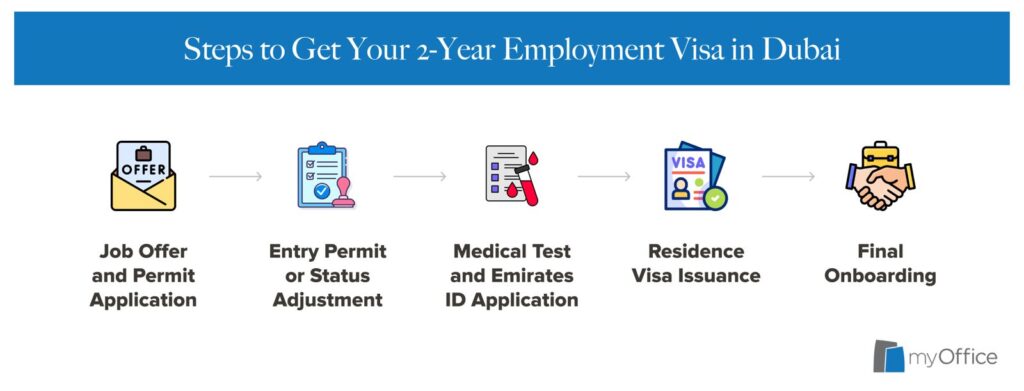
1. Job Offer and Work Permit Application
The process begins once the employer confirms the hire and prepares the official job offer. After the candidate accepts, the employer submits the work permit application to the relevant labour authority, legally authorising the company to employ the individual under its sponsorship.
At this point, the employer provides the employment details required for approval, including the role, contract terms, and company information. Once the permit application is reviewed and approved, the case can move forward to the visa stage.
2. Entry Permit or Status Adjustment
After the work permit approval, the immigration stage begins. If the employee is outside the UAE, an entry permit is issued that allows the individual to travel to Dubai for employment purposes.
If the employee is already in the UAE under another visa type, the process instead proceeds through status adjustment. This step converts the person’s existing immigration status into an employment-based residence pathway without requiring them to leave the country.
3. Medical Test and Emirates ID Application
Once the employee is ready to proceed with residence formalities, the required medical screening is conducted at an authorised centre. The results are submitted electronically to the immigration system, confirming that the applicant meets the medical requirements for residency.
At the same stage, the Emirates ID application is submitted. The applicant provides biometric information during this process, including fingerprint registration and identity verification.
4. Residence Visa Issuance
After the medical screening and identity procedures are completed, immigration authorities proceed with issuing the residence permit. This approval links the employee’s legal residency status to the sponsoring employer.
The residence visa confirms the employee’s right to live in the UAE for the authorised period under the company’s sponsorship.
5. Final Onboarding
Once the residence visa is issued, the employee’s status is fully active under the employer’s sponsorship. At this stage, the company can complete the final onboarding steps, including activating payroll records and internal employment documentation.
With the visa and residence status finalised, the employee can begin working and carrying out their role within the organisation.
Who Pays the Employment Visa Cost in Dubai?
In a standard employer-sponsored scenario, the employer is typically responsible for all recruitment and residency-related expenses. Official UAE guidance on mainland recruitment states that the employer pays the fees for the approval issued by the Ministry and bears the cost of recruiting the worker and obtaining the worker’s residency permit.
This distinction is important for both employers and employees. Workers should be cautious if they are asked to absorb major sponsorship costs in what is supposed to be a standard employment route. Employers, meanwhile, should factor these obligations into hiring budgets from the outset.
Processing Overview
While individual government stages (like those handled by the GDRFA) can move within 48 hours, the total journey involves multiple moving parts that extend the overall duration.
Stage | Key Components | Timeline Expectation |
Initial Approvals | Labour approval and entry permit or visa issuance | Fast (often ~48 hours per stage) |
Status Adjustment | In-country status change (if applicable). | Depends on current visa status |
Identity & Health | Medical fitness testing and Emirates ID biometrics | Subject to appointment availability |
Finalisation | Residence permit completion and stamping | Final step of the administrative change |
Operational Planning | Integration into hiring lead times | Depends on document readiness |
Common Mistakes That Increase Delays or Costs
Avoid these frequent pitfalls to ensure a smoother administrative process and better budget control:
Relying on Standard Quotes: Assuming a single advertised figure applies to everyone is a mistake. Real costs can vary based on employer classification and in-country charges.
Poor Document Preparation: Missing passport details, blurry photos, or delayed medical steps can halt a manageable process and add unnecessary administrative overhead.
Treating Visas in Isolation: Visa processing should not be disconnected from business licensing or compliance. Separating these tasks often leads to duplicated efforts and avoidable errors.
Ignoring the Timeline: Underestimating the buffer needed for appointments and external dependencies can disrupt operational planning and start dates.
Note: Because regulations and fees in the UAE can shift based on Ministry of Human Resources and Emiratisation (MOHRE) updates, it’s always worth double-checking your company category and fee requirements before filing.
Why Businesses Use Professional Visa Support
As hiring grows, visa processing becomes just one part of a broader business workload. Even when the requirements seem clear, companies often need a reliable system to keep applications aligned with recruitment, onboarding, and internal planning.
For companies that need that kind of assistance, we help by supporting the process in a practical and organised way. Our team works with businesses on the documentation, submission flow, and coordination involved, helping employers move through each stage with clearer direction and the right support where it is needed.
Simplify Your Employment Visa in Dubai
As businesses continue to expand in Dubai, employment visas remain a key part of bringing new talent into the country. A clear understanding of the process and expected costs helps employers plan hiring timelines more effectively while giving employees a smoother start to their role.
For companies that prefer a more structured approach, having the right support can make the process easier to manage. We work with businesses to help organise the documentation and coordination involved, allowing employers to move forward with hiring in Dubai with greater clarity and confidence.


" height="24px" id="lngUwvl9j" width="24.0000007312145px"/><g d="M 1.925 0 C 1.925 0 15.99 1.45 17.396 2.148 C 17.449 2.795 17.572 4.891 17.572 4.891 C 17.572 4.891 9.256 6.114 9.08 6.236 C 9.027 6.533 7.973 21.659 8.148 24 L 0.008 24 C 0.008 24 -0.238 7.686 1.925 0 Z M 21.466 4.88 C 21.466 4.88 23.523 12.741 22.873 23.797 L 8.685 23.797 C 8.685 23.797 9.564 8.426 9.617 6.679 C 10.742 6.627 21.466 4.88 21.466 4.88 Z" fill="transparent" height="24px" id="Z2jQXORih" width="22.999999859819656px"><path d="M 1.925 0 C 1.925 0 15.99 1.45 17.396 2.148 C 17.449 2.795 17.572 4.891 17.572 4.891 C 17.572 4.891 9.256 6.114 9.08 6.236 C 9.027 6.533 7.973 21.659 8.148 24 L 0.008 24 C 0.008 24 -0.238 7.686 1.925 0 Z" fill="rgba(109, 110, 112, 0)" height="24px" id="uRCSoYpF9" transform="translate(0 0)" width="17.571788860132756px"/><path d="M 12.781 0 C 12.781 0 14.838 7.86 14.188 18.917 L 0 18.917 C 0 18.917 0.879 3.546 0.932 1.799 C 2.057 1.747 12.781 0 12.781 0 Z" fill="rgba(19, 118, 189, 0)" height="18.917030567685604px" id="wgj7RvRWd" transform="translate(8.685 4.88)" width="14.314947941789871px"/></g></svg>)